> ## Documentation Index
> Fetch the complete documentation index at: https://polar.sh/docs/llms.txt
> Use this file to discover all available pages before exploring further.
# Customer Portal
> The self-service destination for your customers
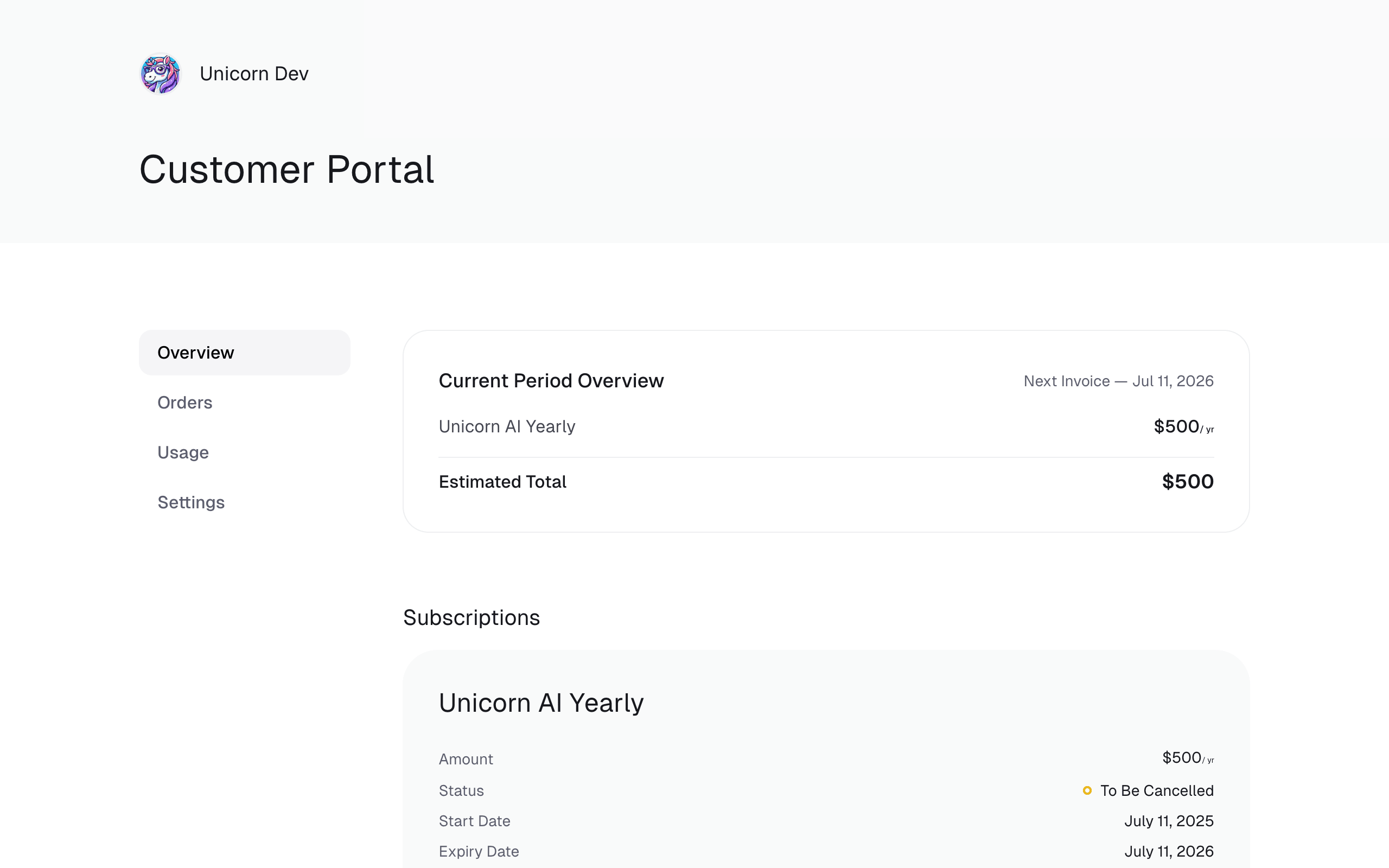
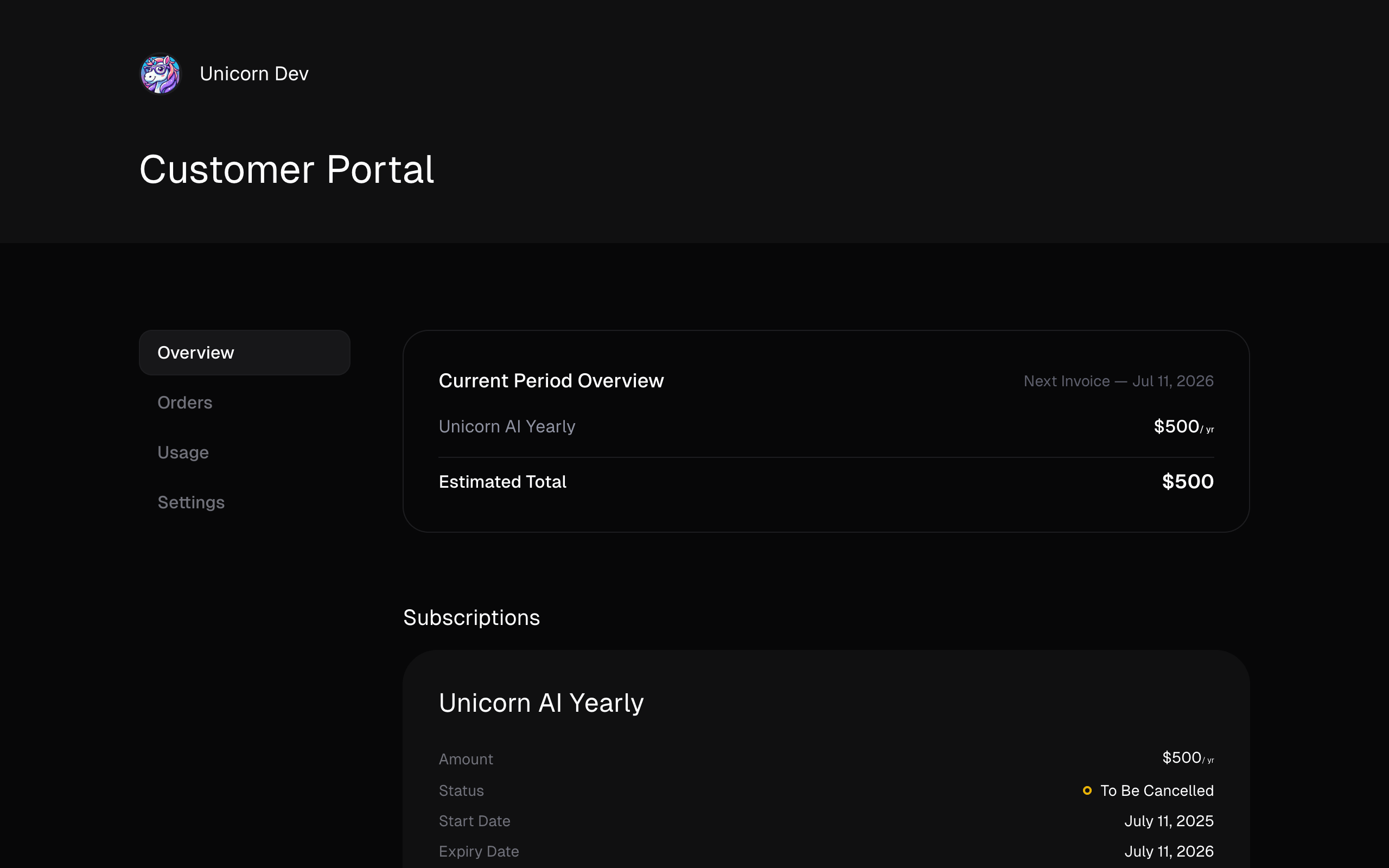
The Customer Portal is a hosted, self-service page where your customers can manage everything related to their relationship with your business — without having to email your support team.
 ## What customers can do
From the Customer Portal, your customers can:
* View their **active subscriptions** and past **purchase history**
* **Download and edit invoices** (e.g. add a company name, VAT number, or billing address)
* **Download payment receipts** for every paid order, with the payment method and any refunds
* **Access benefits** they're entitled to — license keys, file downloads, Discord access, etc.
* **Cancel active subscriptions** on their own
* **Update their default payment method** — the primary way for customers to recover from failed payments
* Optionally, change their email address, switch subscription plans, manage seats, and view metered usage (see [Settings](/features/customer-portal/settings))
## Why it matters
The Customer Portal isn't just a convenience feature — it's a critical piece of your billing stack:
* **Failed payment recovery.** When a subscription renewal fails, the portal is where customers update their card so they don't lose access. Because Polar is PCI-compliant, you never have to handle card details yourself.
* **Self-service cancellations.** Some jurisdictions (notably California under the [Automatic Renewal Law](https://oag.ca.gov/consumers/auto-renewing-subscriptions)) legally require customers to be able to cancel a subscription the same way they signed up. The Customer Portal satisfies that requirement out of the box.
* **Invoice and receipt access.** Customers retrieve and edit their invoices, and download a receipt for any paid order, without pulling you into a support thread.
## Next steps
Use the default portal URL, generate authenticated links, or rely on the
emails Polar already sends.
Configure what your customers can do from the portal under Settings → Customer portal.
Build your own portal experience on top of the Customer Portal API.
## FAQ
**No.** The Customer Portal is always available for your customers, and it
can't be turned off.
This is a deliberate design decision. The portal is how we guarantee that
your customers can always:
* **Access their invoices and payment receipts** for tax and bookkeeping.
* **Cancel their subscriptions on their own**, which is legally required in
some jurisdictions (for example California's [Automatic Renewal Law](https://oag.ca.gov/consumers/auto-renewing-subscriptions),
which requires that customers be able to cancel the same way they signed
up).
* **Update their payment method in a PCI-compliant way**, so they can
recover from failed renewals without you having to handle card details.
You can, however, [fine-tune what customers can do](/features/customer-portal/settings)
from the portal — for example, disabling subscription plan changes or email
edits.
Not the hosted portal at `polar.sh//portal` — it's
intentionally consistent across all Polar organizations.
If you need a branded experience, you can build your own portal on top of
the [Customer Portal API](/api-reference/customer-portal/get-customer),
which covers the day-to-day actions: viewing subscriptions and orders,
downloading invoices and receipts, managing benefits and seats, and reading
meter usage.
Not every action is exposed through the Customer Portal API. Most
notably, **updating a default payment method** is only available from the
hosted Customer Portal — this is what keeps you PCI-compliant, since card
details never touch your servers. Customers you send into a custom portal
will still need the hosted one to recover from failed payments.
By default, customers authenticate with the email address they used to
purchase or subscribe — Polar emails them a one-time code to confirm.
You can also skip the email step entirely by generating a pre-authenticated
link from your own application. See [Navigate customers to the portal](/features/customer-portal/navigate-customers)
for details.
You don't have to. Polar already includes a link to the Customer Portal in
the transactional emails it sends — order confirmations, subscription
renewal notices, failed payment alerts, and more.
You may still want to link to it from your own app for convenience, but
it's not required for customers to be able to reach it.
The customer receives an email from Polar letting them know, with a link to
the Customer Portal where they can update their default payment method.
Once they do, Polar automatically retries the charge.
This self-service flow is the primary way customers recover from failed
renewals — keep it in mind when you're thinking about churn.
## What customers can do
From the Customer Portal, your customers can:
* View their **active subscriptions** and past **purchase history**
* **Download and edit invoices** (e.g. add a company name, VAT number, or billing address)
* **Download payment receipts** for every paid order, with the payment method and any refunds
* **Access benefits** they're entitled to — license keys, file downloads, Discord access, etc.
* **Cancel active subscriptions** on their own
* **Update their default payment method** — the primary way for customers to recover from failed payments
* Optionally, change their email address, switch subscription plans, manage seats, and view metered usage (see [Settings](/features/customer-portal/settings))
## Why it matters
The Customer Portal isn't just a convenience feature — it's a critical piece of your billing stack:
* **Failed payment recovery.** When a subscription renewal fails, the portal is where customers update their card so they don't lose access. Because Polar is PCI-compliant, you never have to handle card details yourself.
* **Self-service cancellations.** Some jurisdictions (notably California under the [Automatic Renewal Law](https://oag.ca.gov/consumers/auto-renewing-subscriptions)) legally require customers to be able to cancel a subscription the same way they signed up. The Customer Portal satisfies that requirement out of the box.
* **Invoice and receipt access.** Customers retrieve and edit their invoices, and download a receipt for any paid order, without pulling you into a support thread.
## Next steps
Use the default portal URL, generate authenticated links, or rely on the
emails Polar already sends.
Configure what your customers can do from the portal under Settings → Customer portal.
Build your own portal experience on top of the Customer Portal API.
## FAQ
**No.** The Customer Portal is always available for your customers, and it
can't be turned off.
This is a deliberate design decision. The portal is how we guarantee that
your customers can always:
* **Access their invoices and payment receipts** for tax and bookkeeping.
* **Cancel their subscriptions on their own**, which is legally required in
some jurisdictions (for example California's [Automatic Renewal Law](https://oag.ca.gov/consumers/auto-renewing-subscriptions),
which requires that customers be able to cancel the same way they signed
up).
* **Update their payment method in a PCI-compliant way**, so they can
recover from failed renewals without you having to handle card details.
You can, however, [fine-tune what customers can do](/features/customer-portal/settings)
from the portal — for example, disabling subscription plan changes or email
edits.
Not the hosted portal at `polar.sh//portal` — it's
intentionally consistent across all Polar organizations.
If you need a branded experience, you can build your own portal on top of
the [Customer Portal API](/api-reference/customer-portal/get-customer),
which covers the day-to-day actions: viewing subscriptions and orders,
downloading invoices and receipts, managing benefits and seats, and reading
meter usage.
Not every action is exposed through the Customer Portal API. Most
notably, **updating a default payment method** is only available from the
hosted Customer Portal — this is what keeps you PCI-compliant, since card
details never touch your servers. Customers you send into a custom portal
will still need the hosted one to recover from failed payments.
By default, customers authenticate with the email address they used to
purchase or subscribe — Polar emails them a one-time code to confirm.
You can also skip the email step entirely by generating a pre-authenticated
link from your own application. See [Navigate customers to the portal](/features/customer-portal/navigate-customers)
for details.
You don't have to. Polar already includes a link to the Customer Portal in
the transactional emails it sends — order confirmations, subscription
renewal notices, failed payment alerts, and more.
You may still want to link to it from your own app for convenience, but
it's not required for customers to be able to reach it.
The customer receives an email from Polar letting them know, with a link to
the Customer Portal where they can update their default payment method.
Once they do, Polar automatically retries the charge.
This self-service flow is the primary way customers recover from failed
renewals — keep it in mind when you're thinking about churn.